
Why You Should Check Voltage First When Multiple Warning Lights Come On at the Same Time
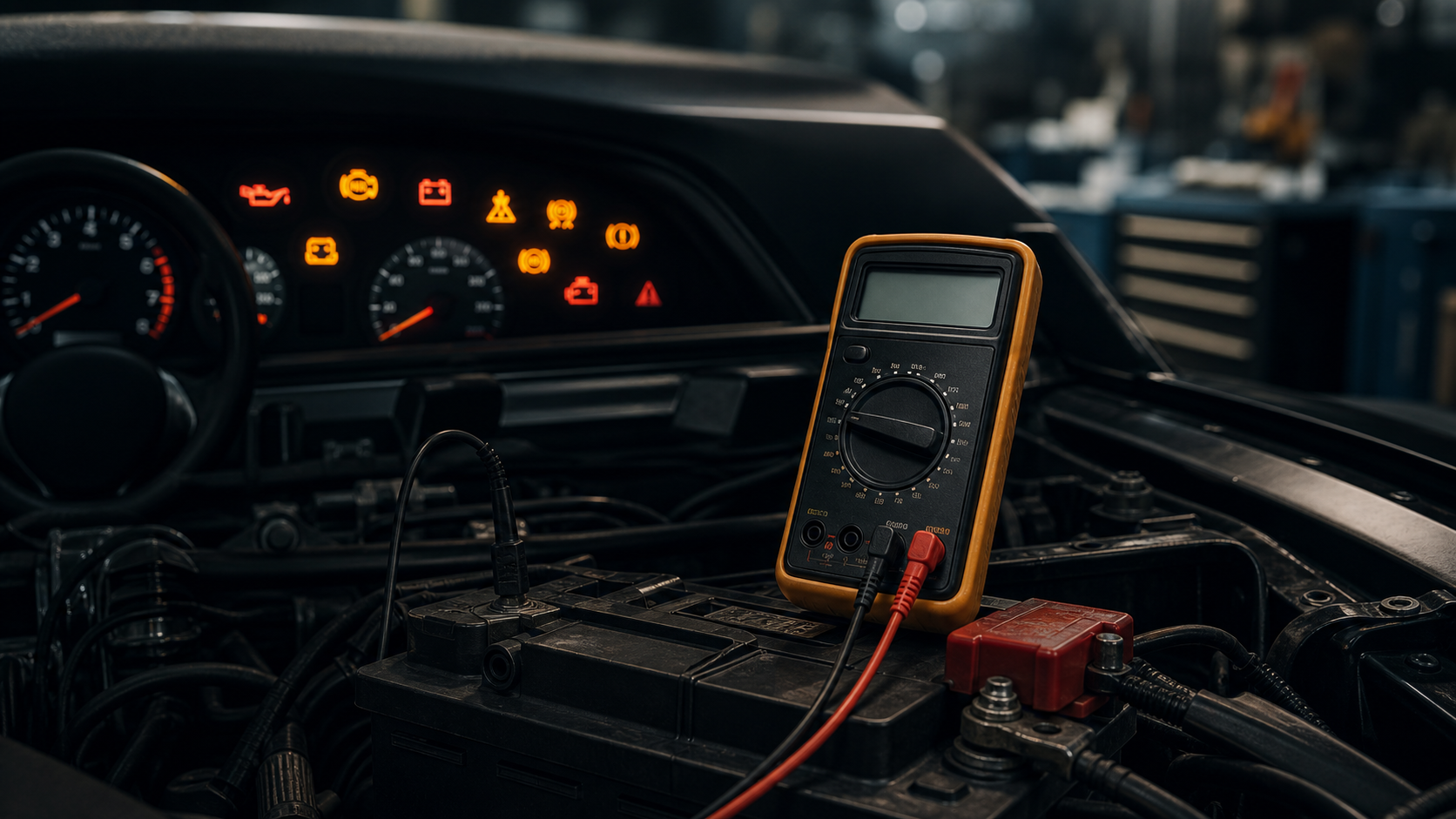
When the ABS, EPS, SRS, and check engine light come on all at once, it is safer to check the Battery, alternator, ground, and communication errors first before looking at multiple parts separately.
What This Article Covers
- The range of issues that multiple warning lights may indicate
- Why voltage and ground checks should come first
- How to handle codes that remain after a voltage issue
- Questions to ask the repair shop
Risk Signals to Check First
- If the engine stalls while driving, steering assist is lost, or brake issues occur together, reduce driving and prioritize an on-site inspection.
- If safety warnings appear together in Hybrid/EV vehicles, checking with specialized equipment should come first.
Common Misunderstandings
- Multiple warning lights do not immediately mean there are problems with multiple parts.
- Low voltage, alternator, or ground issues can cause warnings from several systems to appear together.
- If ABS or SRS codes remain even after the voltage issue is resolved, each system needs a dedicated scan.
What to Check Before Going to the Repair Shop
- Photos of all warning lights
- Battery voltage and charging voltage
- Whether the Battery was recently replaced, discharged, or jump-started
- Full scan results
- Whether communication error codes are also present
Questions to Ask the Repair Shop
- Did you measure the Battery voltage and the alternator charging voltage?
- Did you check the ground condition?
- Did you separate current codes from past codes?
- Are communication errors also present?
- Do ABS/SRS codes remain even after the voltage has normalized?
Example Case
Here is an example case.
When the vehicle was started, the ABS, EPS, SRS, and check engine light all came on at once. The owner was concerned that several parts had failed at the same time, but the Battery had been weak a few days earlier and there was a history of a jump start.
In this situation, you should not estimate multiple separate parts based only on the number of warning lights. Battery voltage, alternator charging voltage, ground, and communication errors should be checked first. Low voltage or ground issues can leave errors in multiple control modules at the same time.
If ABS or SRS codes remain after the voltage is normalized, then you can move on to a dedicated scan for each system. The sequence is not “replacement by part,” but “check the power supply condition, then separate the remaining codes.”
Next Steps
If you have photos of the warning lights and full scan codes, you can organize them first with Free Triage, and if you have a repair estimate, it can be considered as a candidate for Mechanic Prep.
This article is not intended to decide on repairs on your behalf or instruct part replacement. It is reference material for reviewing warning lights, DTC (Diagnostic Trouble Code) codes, photos, and repair estimates more accurately with a repair shop. If there are safety-related warnings or significant abnormalities while driving, an on-site inspection should take priority over online information.